How many the region holds — counted exactly, and proven both ways.
FIT · carrying capacitydual-witnessedexact where 2128 is impossible
Cislunar space is not a smooth field you sprinkle craft into — it is a crystal of stable orbit
families separated by bands of chaos, and two craft whose resonances overlap tear each other's orbits
apart. So a region has a carrying capacity: a hard maximum number of collision-free families.
Everyone estimates it by sampling; sampling is blind to the exact edge, and the honest count —
enumerate every arrangement — is 2N and dies at a few dozen shells.
Noether Capacity counts it exactly. The overlap rule snaps to an integer-exact threshold, so the
capacity at every perturbation level follows from a finite computation done once — and the answer
ships with a two-sided proof: a set of craft that achieves the count, and a set of witnesses that
forbids one more. No enumeration, at any scale.
A sampled capacity is a guess with error bars. This one is a number with a proof that it cannot be
beaten.
THE PROBLEM How many craft can a cislunar shell lattice
hold at a given perturbation level — exactly, and certifiably — without enumerating
arrangements no machine can enumerate?
THE RESULT The exact count, both directions, at a scale
the referee cannot reach:
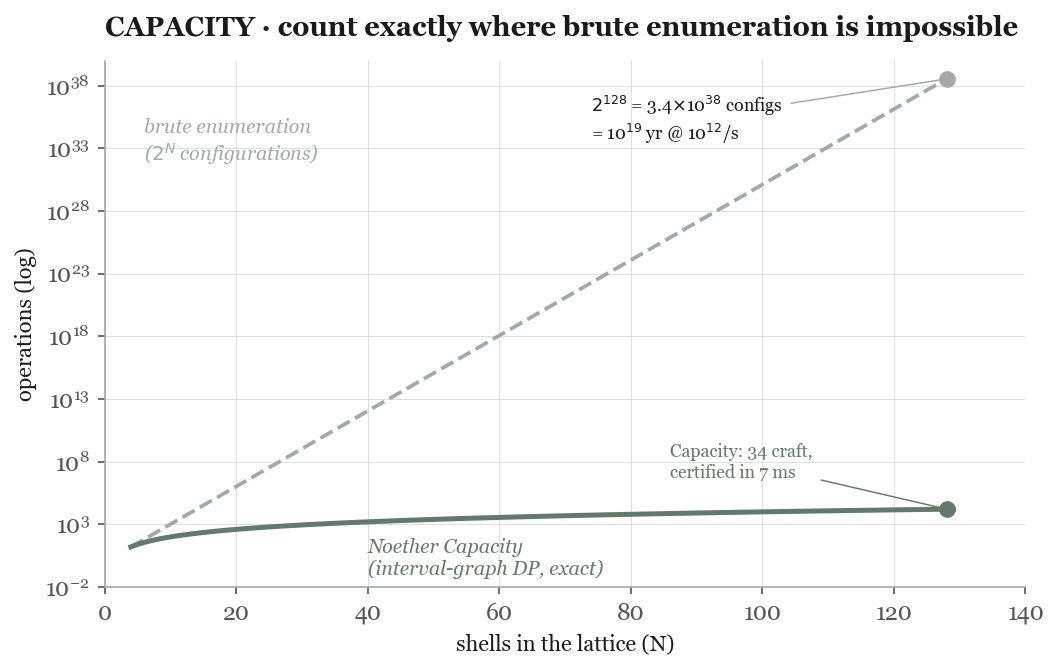
The count, exactly. A 128-shell lattice holds exactly 34 craft at the reference
perturbation — with the full census (8.7×10¹⁶ allowed configurations) counted,
not sampled, in milliseconds.
Proven both ways. The certificate carries 34 pairwise-disjoint shells (the count is
reached) and 34 piercing points (no 35th arrangement exists) — a third party checks both
with no enumeration, in exact arithmetic.
Where the referee is impossible. Brute enumeration of that lattice is
2128 = 3.4×1038 configurations — 1019 years at a
trillion checks a second. The exact census is polynomial; the answer is milliseconds.
Every perturbation level at once. The whole capacity curve — how the count falls as the
region is stressed — is a single exact staircase, computed once, verified from the file.
Count exactly where enumeration is impossible. Brute enumeration is 2N — at 128
shells, 3.4×1038 configurations no machine will ever check; the exact census is
polynomial, milliseconds, with a two-sided proof. Model-tier: exact statements about the stated
exclusion lattice.
The census — and the proof that stands in for it
Step
What was established
The number
The snap
the overlap rule between two orbit shells snaps from a floating-point test to an integer-exact threshold — the whole exclusion structure over all perturbation levels from one finite computation
exact thresholds · computed once
Three-way check
at the reference perturbation, the exact census agrees with the research crystal's own float model and a direct enumeration — and reproduces the recorded Fermi level
agree 3-way · capacity 5 at small scale
The dual witness
at 128 shells: a set that reaches the count, and a set that forbids one more — both verified in exact arithmetic, no enumeration
34 disjoint + 34 piercing
Beyond the referee
the brute census is 2128 configurations; the exact census and the full capacity staircase are computed and verified in milliseconds-to-seconds
2128 → ms
Capacity steel thread — measured audits; the exclusion model (Chirikov overlap) is the cislunar research arc's own, with the physics validated there; this instrument transports the model's exact consequences and states its model tier plainly.
How — the snap, the intervals, the witness
The exclusion rule is an integer. Two shells conflict when their
resonances overlap; that condition snaps to an exact rational threshold, so the entire capacity structure
over every perturbation level is fixed by a finite set of integers computed once. The engine is sealed;
the mathematics is published.
compute once, transport to every level
Capacity is an interval problem. Shells are intervals on the frequency
line, so the count is exact by a polynomial algorithm — where enumerating arrangements is
2N.
polynomial census vs 2N brute
Proven both ways. The certificate carries a set that achieves the count and
a set of piercing points that forbids one more — a third party checks achievability and
impossibility with no enumeration.
the dual witness
The answer is a certificate. The count, the census, and the full capacity
staircase re-derive from the file alone; issuance is mint-locked.
verify · status · mint