Certified endurance — and certified remaining life, with a warrant that voids itself.
CAPTURE · prognosticsISO 13374 lifecycleRUL 18 yr, not simulated
Every solver vendor sells uncertified convergence — run until the residual looks flat, one
trajectory, no guarantee. Every condition-monitoring vendor sells an RUL estimate — noisy,
uncertified, and silent about its own error. And for a 15-year asset the one number that matters —
how long until I must act — is exactly the number you cannot get by simulation: you can't
run the mission to find its remaining life.
Noether Capture certifies both ends of that question. It certifies that a system captures into its
final state, and by when — one witness covering every trajectory for all time. And on a
monitored asset it runs the full lifecycle — detect, classify, trend — to a certified
Remaining Useful Life, with a warrant that self-voids the instant the fault outruns its own
projection. Certification is a state, not a stamp; unverified change decertifies.
Everyone else's certificate tells you it was true once. This one knows when it has stopped being
true, and says so before you ask.
THE ASSET A tether — the astronaut safety line at
parity with the open-source eigensolver, scaled to the lunar space elevator, the most dangerous
safety-of-life structure there is, whose mission life no conventional simulation can reach.
THE RESULT The full ISO 13374 lifecycle, certified
end to end:
One witness, every trajectory, all time. A verified spectral certificate proves the system
captures into steady state for every initial condition and all K — where a referee can
step only finitely many trajectories to finite depth. Theorem-grade: no floating point in the
verdict.
Diagnose by the exact signature. Fault type from the mode comb — mass accretion (modes
down), section loss (modes up), distributed — blind, with the sign as the safety call: a
tiny up-shift is the life-limiting section loss a naive monitor dismisses.
Remaining life, certified, not simulated. On the 56,000-km elevator: a section-loss fray
localized to 606 km, trended, and a Remaining Useful Life of 18 years certified without
simulating 18 years — where a mission-life FEM is ~30,000 years of wall-clock.
The warrant voids itself. A fault on its projection stays certified; one that outruns its
trend voids the certificate automatically — act now. Swap a sensor, touch a limit, go
blind: the monitor decertifies. Verifiable offline, through the lunar night.
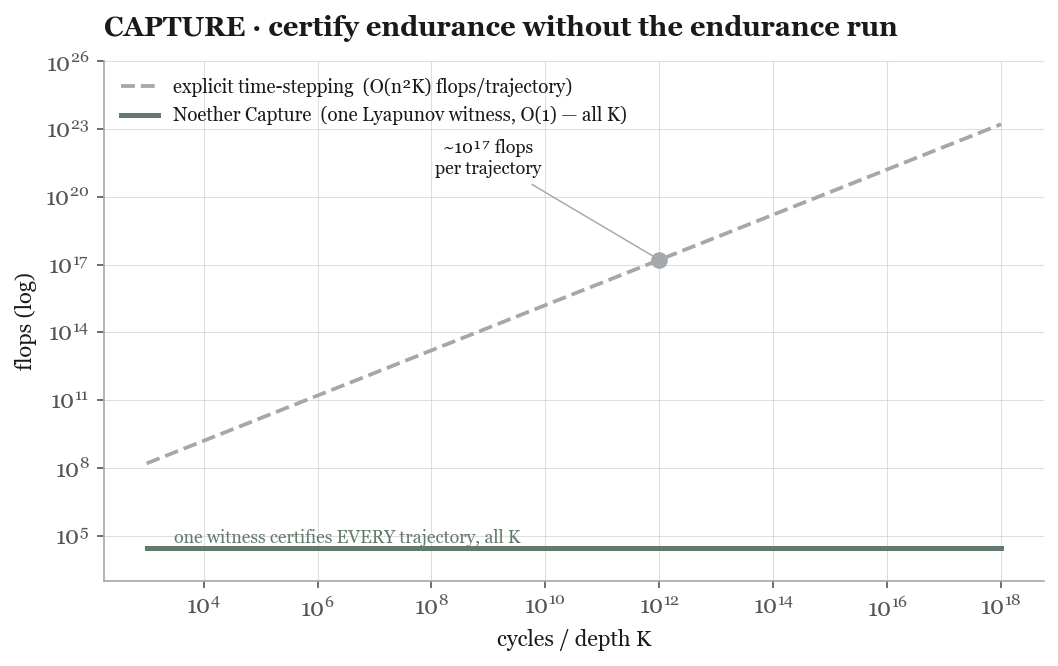
Certify endurance without the endurance run. Explicit stepping is O(n2K) flops per
trajectory — ~1017 at a decade-mission depth, and it certifies only the trajectories it
runs; one verified Lyapunov witness certifies every trajectory for all K, at constant cost. The
exact tier carries no floating point in the verdict.
The lunar-elevator lifecycle — ISO 13374, end to end
Block
What was established
The number
Detect & locate
a section-loss fray on the 56,000-km cable found and localized from one vibration record, through an exactly-subtracted climber
localized to 606 km
Classify
fault type from the exact modal signature — section loss reads as a mode up-shift (the life-limiting sign), blind
type 7/7 blind
Trend
the growth rate from a monitoring history, with runaway (accelerating) faults flagged automatically
rate exact · R2 1.00
Remaining life
state × trend × the design threshold → a certified RUL, where the mission-life FEM is ~30,000 years
18 years, certified
Auto-decert
a fault on its projection stays certified; one outrunning the trend voids the warrant — live
on-trend / outrunning → VOID
Capture & lifecycle steel threads — measured audits; parity referee the open-source symmetric eigensolver; a spectral-gap constant to 40 digits; the design threshold from the constant-stress tether. A demonstration of the certified-lifecycle capability, not a flight-qualified structural-health system.
How — the witness, the signature, the self-voiding warrant
One witness for all trajectories. A verified certificate bounds the
system's contraction to steady state for every initial condition and all time — the composed
answer to “does it settle, and by when.” The engine is sealed; the mathematics is published.
exact tier: no float in the verdict
Read the fault, name it, trend it. The mode comb gives detection and
localization; the exact signature gives the fault type; a sequence of readings gives the growth rate and
flags runaway.
ISO 13374 Health Assessment
Remaining life is the composition. Current state (resolved), growth
(trended), and the design limit combine to a certified Remaining Useful Life — the answer you
cannot get by running the mission.
state × trend × design threshold
The warrant is a state. It self-voids when the fault outruns its
projection, when a component's behavior changes, or when the monitor goes blind — and its whole
history is a sealed, offline-checkable chain in which a safety limit cannot change quietly.
verify · status · mint