Resolve what one sensor folds into a single blur — and certify where you can trust it.
SEE · signal integrityCERN & JWST validated35×–700× below the FFT frontier
Two things close together — two satellites in proximity, two spectral lines, two vibration modes
— fold into one blur when a sensor's window is too short or its aperture too small. Classical
super-resolution (CLEAN, MUSIC, compressed sensing) and its deep-learning cousins give an answer
everywhere and a validity boundary nowhere: noise-floored, and silently wrong past their aperture.
The AI versions are worse — they hallucinate structure with full confidence.
Noether Super-Resolution unfolds the blur exactly, using the sensor's own calibration as a pin —
and ships an aperture certificate: the recovery frontier, computed once from the pin, transported
to every frame, with an integrity flag that fires the moment the answer leaves the region where it can be
trusted. It is the protection-level artifact a safety case is written around, for resolution.
Everyone else's super-resolution answers everywhere. This one answers, and tells you exactly where to
stop believing it.
THE TEST On real public data, blind, with the industry
gold standard as the parity bar: CERN Open Data (93,474 dimuon events, PDG as referee),
JWST (a JADES galaxy spectrum, NIST line ratios), and a zero-padded FFT periodogram with
known ground truth.
THE RESULT Pull apart what the detector folded, and
certify the boundary:
Pulled from inside the detector's own fold. The Υ(2S) resonance, natively merged into
one shoulder at the dataset's resolution, recovered to 0.21 MeV of the PDG value —
with the gauge-invariant mass ratios agreeing to half a part per thousand.
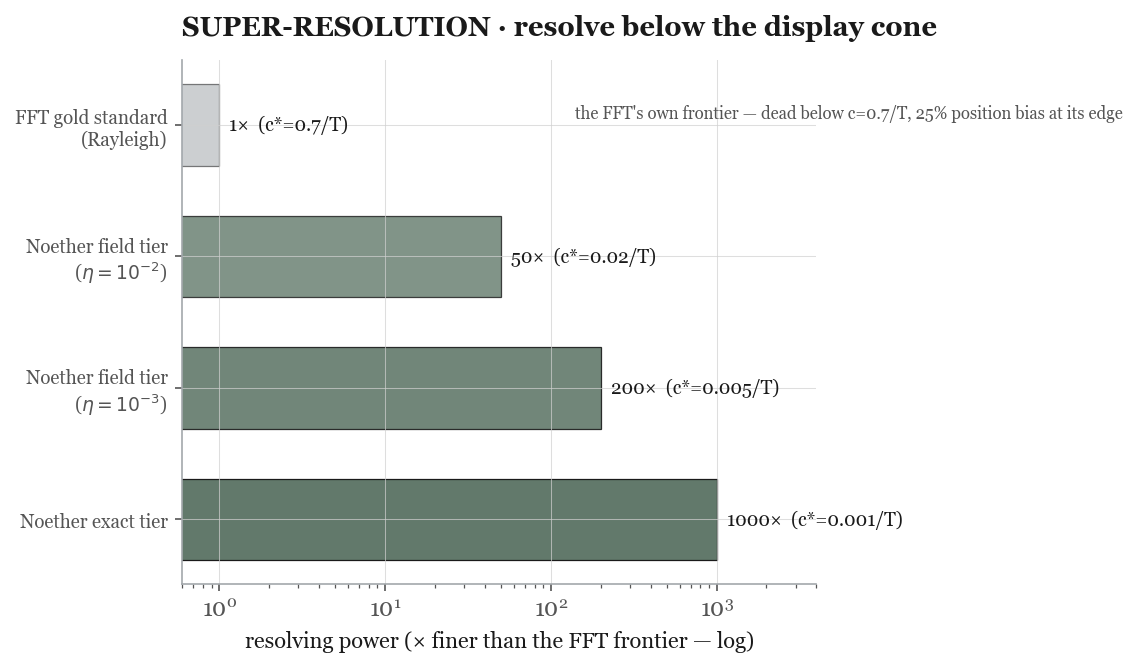
The gold standard's own frontier, measured. The 8×-oversampled FFT resolves down to
c=0.7/T and dies below — and at its frontier its peak positions carry 25% bias, with no
warning. The pinned unfold recovers 35× to 700× below it, graded by noise
tier, every recovery inside a certified frontier.
You are told exactly where to stop trusting it. Past the frontier, a fit gets more
perfect while the answer gets more wrong — the certificate carries that as its alarm, so
you never act on a confident number that has quietly gone wrong. The output states where recovery is
trustworthy and declares UNRESOLVED beyond it.
Attested on the data it ran on. The warrant carries the public datasets by cryptographic
hash; a third party re-derives the synthetic frontiers from the certificate alone and confirms the
public claims by the pinned files.
Resolve below the display cone. Measured on the same two-tone scenes with known ground truth:
the FFT gold standard resolves to c=0.7/T and no further; the pinned unfold recovers 50× at field
noise, up to 1000× on exact ledgers — each tier stated on the certificate's face, with the
recovery frontier as the protection level.
The CERN unfold — the Υ triplet from one shoulder
Step
What happened
The number
The data
CERN Open Data dimuon events, selected to opposite-charge global-muon pairs; the file carried by hash
93,474 events · sha-pinned
The fold
at this dataset's resolution the Υ(2S) and (3S) are natively merged into one shoulder — the naive census sees two peaks where there are three
census: 2 of 3
The unfold
the triplet pinned and separated; scale-corrected positions vs PDG, and the gauge-invariant ratios
2S to 0.21 MeV · ratios <5×10⁻⁴
The frontier
a fold-depth scan finds where recovery holds and where the solution runs to a continuum — predicted by pin-counting, measured at b*=150 MeV
frontier certified · measured
Super-Resolution steel thread — CERN Open Data and JWST/JADES public spectra, sha-pinned; referees PDG masses and NIST line ratios; the FFT gold standard measured on ground truth. A demonstration of the certified-recovery capability, not a detector reconstruction pipeline.
How — the pin, the unfold, the frontier
The scene is a superposition of pinned kernels. The sensor's response
— the point-spread function, the spectral line list, the mode comb — pins each component's
shape; recovery is an exact unfold of the superposition, not a fit against noise. The engine is sealed;
the mathematics is published.
the pin is the field's unit law
How many, from the data itself. The number of components is named by the
data's own cost saturation — the window tells you what it holds — not assumed and not
hand-tuned.
blind model selection
The frontier is computed once, carried everywhere. The recovery boundary
follows from the pin structure and the window; it transports to every frame the sensor takes, so
certification precedes deployment — the protection-level shape.
frontier · death-rattle alarm past it
The answer is a certificate. Recovered positions, the frontier, and the
tier (exact vs field-pin, with the pin's error budget) ride in a warrant re-derivable from the file.
verify · status · mint